Featured

What is digital rhetoric?

I entered this class with a vague idea of what it would be teaching. Now that I’ve listened to introductions on its topics, I’m fairly confident this class will equip me with invaluable skills for today’s world. When I think of digital rhetoric, I think of the Internet’s writing. I think of websites, social media posts, articles, PDFs, and videos. I think of how the creators of this content take special care to visually present their message with the right fonts, formats, colors, and images. Then I think of how eager I am to apply these tools of digital rhetoric to my own media platforms.

Since the early summer of 2019, I’ve been investing my time and energy into building an author website and Instagram page. I primarily post on Instagram, but when I do post on the blog, I promote it on Instagram and include the link in my bio. I’ve worked hard to achieve a visually pleasing aesthetic while remaining true to my style and my goals with the platforms. Yet I hope to learn how to develop the best methods of communicating digitally so I might reach my target audience and accumulate followers and readers.
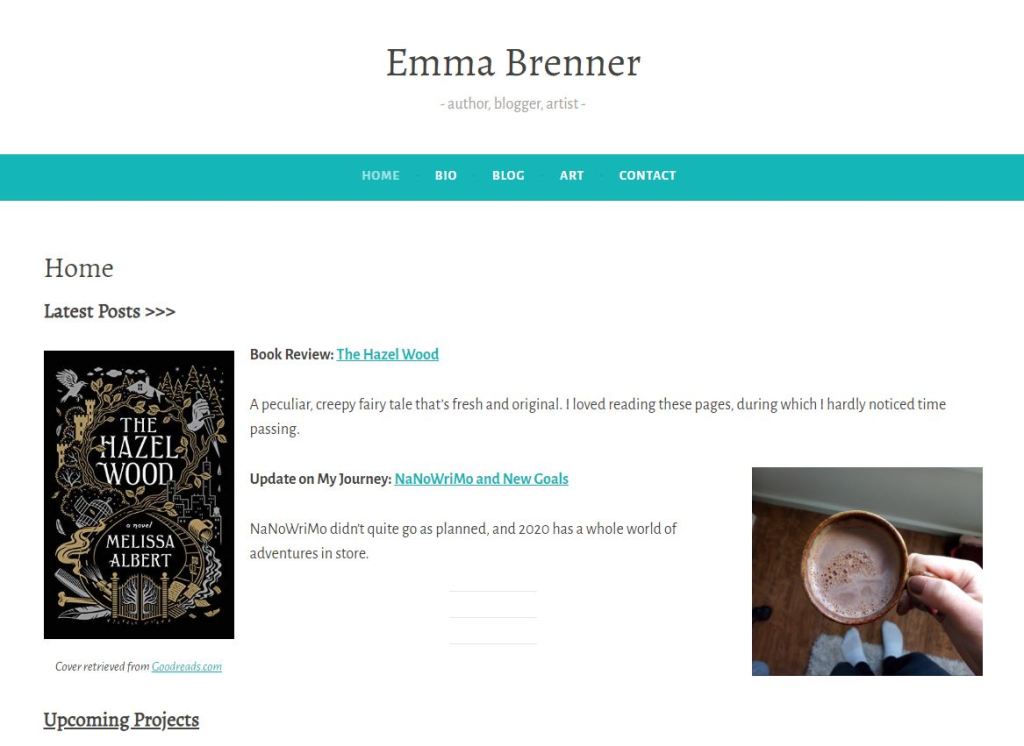
Home Page from emmabrenner.com

Above is home page for my author website and blog. Before even knowing what digital rhetoric really was, I tried to make my writing more accessible and noticeable by including links on the home page to two of the most recent posts. While I have yet to traditionally publish any short stories or novels, I have the heading Upcoming Projects under which I share what WIPs I’m working on. With this class, I will apply the tricks of digital rhetoric to boost this page’s appeal and design.
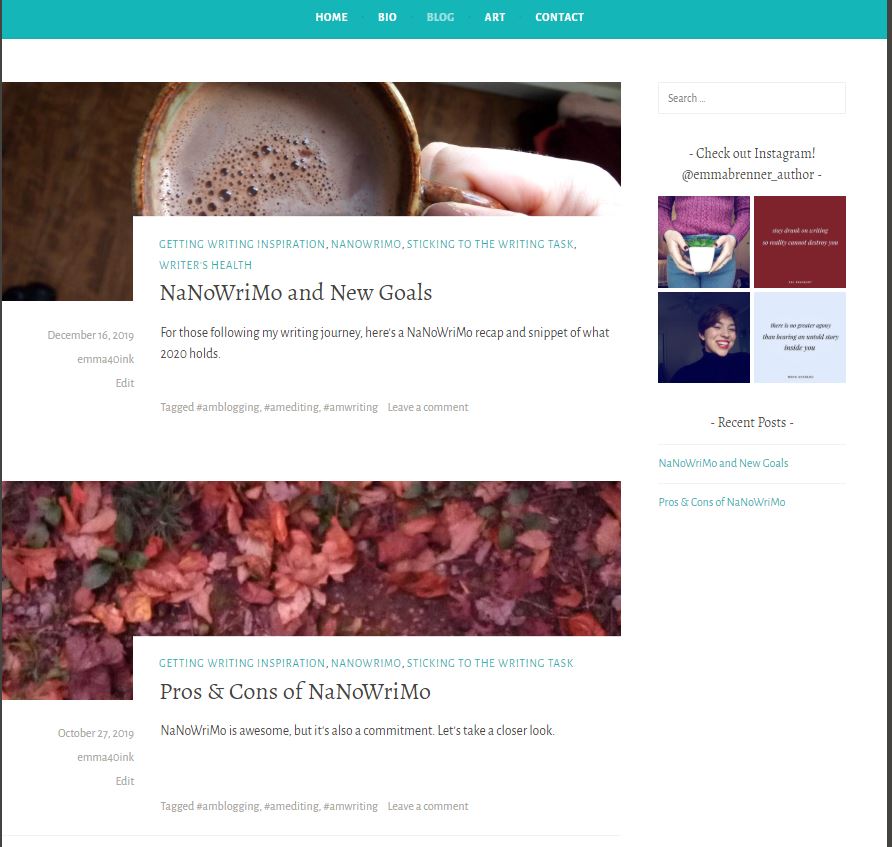
Blog Page of emmabrenner.com

Above is the blog page, or landing page, of my website. There, all my posts are listed with tiny blurbs to strike interest and images that correspond with the pictures used in the post themselves. I took smart, digital writing tips from other websites and bloggers’ advice when creating this organized filing system for the posts. I also took tips from successful authors and included widgets in the right column of the page. There, readers see a couple of recent posts from my Instagram and can click on those images, which takes them straight to my Instagram profile. While I am pleased with the blog page’s design and format, I want to learn how to better write for the medium.

My author Instagram profile

As for the Instagram page, I have recently applied many of the digital rhetoric tools and tips I’ve learned from observation and reading articles on social media success. It wasn’t until a month ago that I began establishing a color palette and aesthetic to my posts. With this change, I created a pattern for my feed, where there’s a quote on a color block for every other post to break up the images. While I like the design so far, and I feel it is clean and visually appealing, learning more of digital rhetoric will allow me to draw on whatever skills I have honed to make them even better. Like with the website, it will educate me on how to write, post, photograph, and tag better for my audience’s tastes.

I am happy with what I’ve accomplished. But I believe digital rhetoric can help me do more.

With this digital rhetoric class, I intend to apply its tools and methods in order to improve these media platforms. I hope to further understand the value of hashtags and to use them in the right places at the right times. I want to understand my audience in a deeper way and learn how to connect with them. I am certain digital rhetoric and its lectures on how to write successfully on digital canvasses will help me achieve this.

“Digital Culturist” vs “Slate”

Relationship between content and design? The Digital Culturist does a much better job of creatively connecting the design of the content with the content itself. Images of various styles clutter its articles, helping visual readers to understand the primary concepts discussed in the text. Slate includes photographs, screenshots, and images of data. This design is less appealing, but it is informative, and it fits with the traditional, professional style of a newspaper.

Digitality? Multimodality? Both websites are easy to navigate. The creators clearly know what they’re doing. The Digital Culturist has a lot more fun exploring different styles of text and presentation, perhaps utilizing different modes of communication. The Slate isn’t particularly boring, but as mentioned before, it follows a formatted style.

Anything notable? The Digital Culturist explores some controversial topics for an academic journal, such as in “Issue 6: Digital Romance” and “Should Software Engineers Care About Ethics?” Slate explores a happy mix of current topics such as COVID-19, an advice column known as Dear Prudence, and an entertainment pieces on the next best show, one suggestion being Miss Fisher’s Murder Mysteries.

Diving Deep: “Slate” Magazine

For a more in-depth analysis, I chose Slate magazine. I appreciated its home page design of space and eye-catching headings.

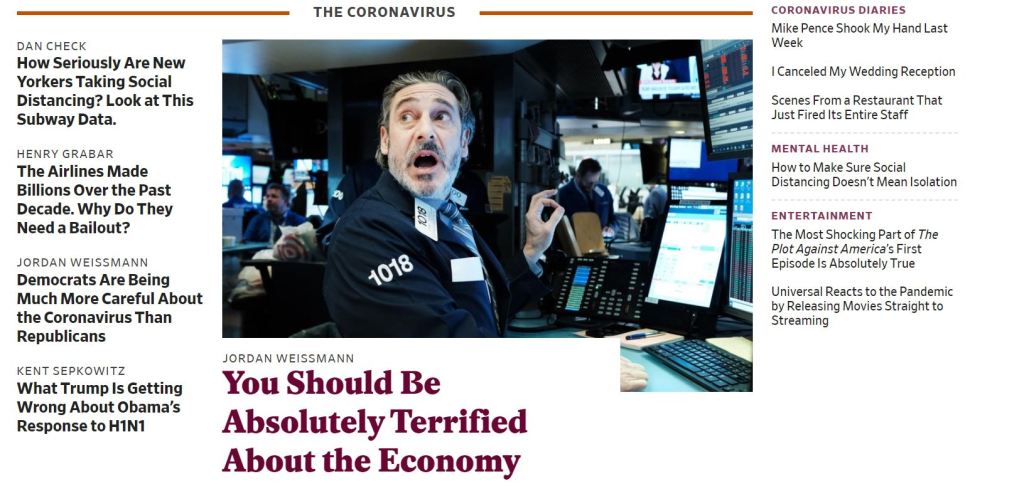
Slate home page, image-focused with snippets of text and a lot of negative, white space.

I particularly analyzed the article “You Should Be Absolutely Terrified About the Economy” by Jordan Weissmann. Here, Weissmann presents the evidence that points toward the United States’s upcoming recession. He supports his argument by quoting well-known politicians and economists who foresee this recession. He also quotes statistics. To strengthen his argument further, he embeds links into his article so that the reader can view the original sources of this evidence.

Pink, underlined texts show embedded links. The last, parenthesized text provides an update on the situation, post-publication.

As for the article’s content and structure, I appreciate its brevity and relevance. COVID-19 dominates the media right now, and with the international travel bans and state shutdowns of businesses, many U.S. citizens have reasonable concerns regarding the country’s future. Weissmann acknowledges people’s fear of the economy’s future from a realistic, and unfortunately pessimistic, perspective. He uses China’s experience with the virus as evidence of that. At the same time, he ends his article on a note of hope, acknowledge how the government may step in to aid financially struggling families.

A quick note worth mentioning is how Slate included an update at the end of the article post-publication. This makes the information accurate and increases the reader’s trust in the source.

Comparing Digital Publications

Academic Journal: Digital Culturist.

This journal has a modern, simplistic design that takes advantage of its negative space. Along with being appealing to the eye, its Our Mission page establishes a casual voice, utilizing imagery that helps the reader to understand its message. Digital Culturist explores the relationship between humans and technology. It recognizes the pervasive role of technology in our lives, and it is determined to help us better understand that role.

Digital Culturist: Our Mission page

Academic Journal: Enculturation.

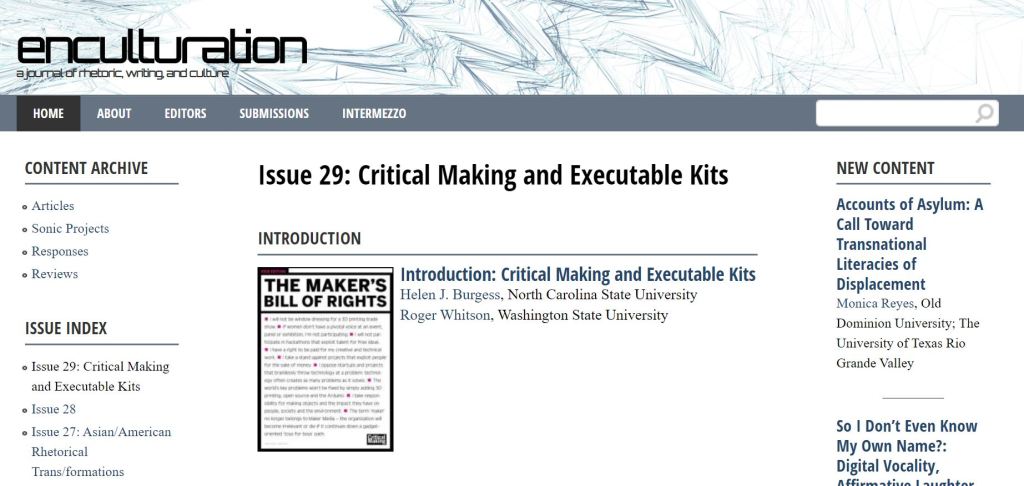
I did not choose Enculturation for its appealing design, but rather for how its traditional, formal design serves as a point of comparison for other digital publications. It is plain, white, and uses Times New Roman for its body texts. The only style deviations are in the menu bar and the busy, confusing, and disorganized heading image that displays the journal’s name. While the visual rhetoric lacks appeal, its About page makes it very clear that the journal appreciates articles and reports that apply multimedia. This artistic claim has a strange contrast with the journal’s unimpressive design.

Enculturation: Home page

Academic Journal: Southern Spaces.

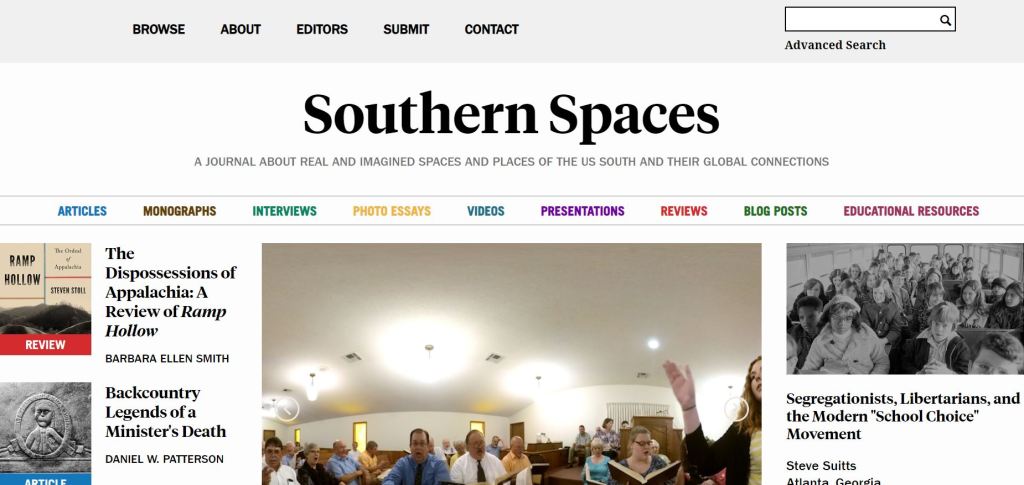
Southern Spaces is immediately eye-catching and engaging with its high use of images, color, and visual hierarchies in text. Additionally, I found the journal’s mission to be an intriguing one. Southern Spaces publishes research and scholarly articles that discuss the culture, spaces, and ideas, “real and imagined,” that particularly take place in the U.S. South.

Southern Spaces: Home page

News/Culture Publication: Business Insider.

Like Southern Spaces, Business Insider appreciates visual rhetoric with large images and text headings. It leaves more negative space, however, perhaps overwhelming the reader less and increasing readability. There’s no About page, but it’s clear that this journal’s purpose is to publish news on business, politics, and technology.

Business Insider

News/Culture Publication: Huffington Post.

If Southern Spaces to Business Insider were a range from Most Visual Clutter to Least Visual Clutter, Huffington Post would fall between the two. Its design stands out for its widespread use of bold text and a black-colored page heading. Like Business Insider, there’s no About page, but a glimpse at the menu bar shows that it specializes in entertainment, news, life, politics, and reporting updates on popular current events, like the 2020 U.S. elections.

Huffington Post: Home page

News/Culture Publication: Slate.

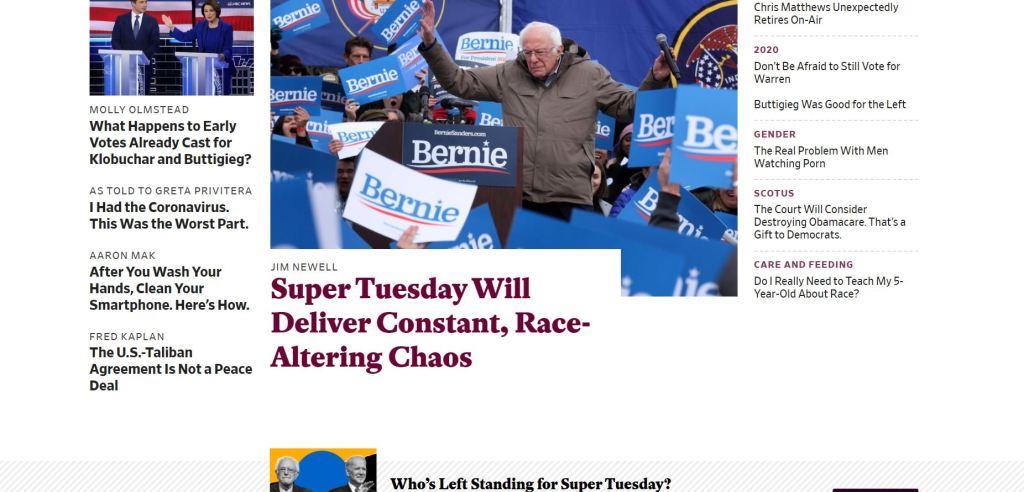
Slate magazine organizes its Home page with clear headings for technology, culture, and more. It contains photographs like the other news sources examined, but it also uses graphic art to communicate the topics of its articles. Like Huffington Post, it utilizes bold text, but it does so selectively, helping the reader to not be overwhelmed by continuous dark, important-looking text. The magazine is known for its “witty take” on news. So while it publishes articles on news, culture, technology, business, and human interests like the other journals, it does so with a unique and interesting style.

Slate: Home page

The Kairos Journal

An Analysis

Audience: teachers, academic institutions, students, scholars. It discusses changes in the world, particularly related to the field of rhetoric, that are relevant to the individuals and organizations involved in writing and technology.

Design: colorful, modern, nontraditional. It pushes back on the old style of academic texts to explore mediums of color, font, and current trends in visual rhetoric. For example, this issue’s venn diagram of copyright, ownership, and authorship caught my attention. It catered to me, a visual learner, and helped my brain to comprehend the issue’s focus.

Compared to Previous Issues: Going back several years, Kairos made use of color, images, and video. But this recent issue fully embraces current design waves, with resembling night mode and playing with dark, negative space. This style is popular, appealing, and challenges old, traditional designs.

A General Discussion

“As new technologies and ways to use them have emerged, so have new issues involving ownership, authorship, and copyright” (Kairos). This thesis statement immediately sound similar to observations on multiliteracies, how new medias have created new literacies. Kairos studies how the Internet and digital media has exploded, focusing on questions of how ownership and licensing should now exist. Should there be more copyright laws or less? Is authorship praised too much or not enough? How do we keep track of ownership? Kairos‘s editors acknowledge the “fluidity” with ownership, authorship, and copyright, the rules of which were once quite clear. They discuss how these three concepts overlap in many ways.

Kairos acknowledges how the available technological infrastructure sets the framework for how rhetoric is created, shared, distributed, licensed, and traced. Similar to how the explosion of new medias led to new literacies, content on digital media has expanded massively, and it does so quickly, in such a way that its original source is often from a collaboration of authors or lost altogether. For example, when a new slang term is developed, it is spread through posts, videos, messages, hashtags, and other means until it is almost impossible to credit the owner/creator of that term. A side effect is that people who are highly literate in that media learn that term, adding it to their vocabulary, and thereby further grow the world of multiliteracies.

Kairos also discusses how these new medias and changing attitudes toward rhetoric have challenged views on authorship and plagiarism. Copyright is a still a prevalent concept, but there are debates from people who believe that content should be shared more openly, that copyrighting certain materials excludes groups of people or ideas. This is similar to Selfe’s argument, where she revisits academia’s worship of written rhetoric. When one way of learning was the only way available, it created an exclusive education, blocking out women and minorities.

One particularly unique concept discussed in “Copyright, Content, and Control: Student Authorship Across Educational Technology Platforms” questions the usefulness of certain educational technology resources. It suggests that while media is expanding, and academia is utilizing it, students may be disadvantaged in terms of control over the content they create and the copyrights over that content. Put quite simply, “we are concerned that educational platforms that are commonly used for learning and teaching do not facilitate or allow for students to exert ownership and control over their own contributions” (Amidan). This article is designed in a casual blog style, with a text-heavy focus and one image.

Contrary to the article on student ownership, two other featured articles present a very different, multimodal style. “A Perspective on Modding and Ownership” provides text with smaller margins, which is less overwhelming for the reader, and a video that directly relates to the article’s content. Samuel Jackson Fuller discusses the incident that occurred when Nintendo shut down a fan-made version of a Pokemon game. In retaliation, other fans gained access to the game and released it anyway, for they believed that it was content worth sharing. Fuller presents a viable solution to this conflict alongside an intelligent discussion on modding and the conflicts of ownership connected to it. The other article featured, “Collaboration And/Against Copyright: Notes Home from the Technology Revolution Battefield,” shares notes on the problematic power of copyright. It does so in an entirely different style than the other articles: Its landing page consists of only a title and images that require the reader to engage with the visual rhetoric and captioned text. It also bravely includes an informal font and illustration for its heading and title, along with a colorful web page background.

Aurality: Overarching Concepts

When reading Selfe’s paper, there are key ideas that you must understand when dissecting her argument.

BIAS.

Bias has had an extremely invasive impact on the world of academia and its view on composition. This bias persists the misconception of how writing is supposedly more “sophisticated” and “complex” than other forms of communication (Sawyer qtd. 629). This bias has controlled the rule on what is considered intelligent, educated, or worthy of praise, thereby excluding vast amounts of information and sometimes entire groups of people.

RACISM.

Closely tied to the poison of bias, racism has held clear notes throughout Western history and literacy. When education was thriving on the written word, it was primarily only available to white males. Women were disadvantaged and so were racial groups, and Selfe spends a great deal of time discussing the oppression of the latter. Hispanics, African Americans, and Native Americans developed their own emphases on which modes of communication were important. Because written composition was less accessible to them, aurality became a tool of resistance and empowerment. For example, Native Americans today see aurality as their way of preserving their culture in a form of “rhetorical sovereignty” (Lyons qtd. 636). It is also worth noting that this racism continues today, like in the oppression of bilingual aurality in states that have a high Spanish-speaking populations.

VOICE.

The idea of aurality is based on sound, particularly the human voice’s capability of forming it and making meaning from it. However, academia has a warped perception on voice. Instead of recognizing it as an oral tool and powerful mode of meaning, it has been defined from a frame of written composition . . . that instead of voice being the literal human feature of sound, it is an abstract idea and tool that contributes to producing the written word. (630) In short, academia’s bias that favors written composition, and the long-held belief equating writing with intelligence, have erased the original meaning of voice.

Aurality: A Summary

Selfe’s entire argument is like our other readings, in that it is not an either/or argument. Rather, she persuades that written composition should be treated as equally as aurality and multimodal composition. She gives her readers a history of the Western world’s bias. Speech and recitation were once valued above all else . . . until they weren’t, and the written word was worshiped and treated as the only true mark of knowledge and education. This shift marginalized minorities and excluded other valid forms of communication.

As Selfe explains in her article, aurality has an undeniable impact on society. New technologies are expanding the uses of multimodal composition (agreeing with our past authors’ observations). Unfortunately, academia equates the written word with intelligence. And with its resistance of technology’s digital wave, aurality is not valued the same as writing is.

Selfe’s call to action asks her readers to push for change in the field of education. Like Cope and Kalantzis, she recognizes the current multiliteracies and how they must be incorporated into education in order to better shape students that are fully equipped for today’s world. Her recount of minorities’ methods of survival, how they managed to compose throughout history in spite of oppression, provides evidence of how different groups of people communicate in various modes of meaning. This further stresses on how important it is that multimodal communication is considered when constructing curriculum.

“Composition in a New Key”: Helpful Terms

The following terms refer to the three big concepts that Yancey believes must be considered when developing a new, relevant, and inclusive composition curriculum.

Circulation of Composition.

Circulation of composition is the the circulation of text across spaces, time, and media, and within educational culture. As Yancey quotes Charles Bazerman and David Russell, this circulation is when “writing is alive” (qtd. 312). Circulation is also known as activity theory, and it involves the remediation of texts across mediums. In other words, when text is moved from one medium to another, it is called remediation, for certain changes are required in order to adjust the text for that medium. With the numerous technological mediums available today, a successful writer must be familiar with this process in order to compose accessible texts.

Canons of Rhetoric.

Yancey recites these well known canons of rhetoric, which are invention, arrangement, style, memory, and delivery. She expands on these canons by pointing out how they are not merely separate entities. Rather, they are all intertwined. One example of this is that “what and how you arrange [a text] . . . is who you invent” (318). This idea is also important as it provides a new outlook on the canons and how they must be applied to composition curriculum.

Deicity of Technology.

The word decity comes from a linguistic term, deixis, which in this context refers to time and how meanings change (318). So the deicity of technology addresses how technology is changing, and therefore literacies are as well. This change opens up new uses and possibilities for composition. Exploring these possibilities is a way of “envisioning,” and one should build this envisioning into a new curriculum (320).

“Composition in a New Key”: A Summary

When looking at the article in its whole, Yancey’s call to action is very similar to George’s. Both women are demanding that composition courses adapt and become more inclusive to the technological and cultural changes of today’s world. George specifically focuses on visual communication, while Yancey tackles the entirety of composition, in how it must be viewed from a new perspective altogether.

Yancey, like the writers on multiliteracies, begins her argument with addressing how composition has evolved. Much of this evolution has taken place outside the classroom. So as not to become obsolete (a legitimate fear, considering the shrinking number of English departments) curriculum must adapt to the evolution (302). Her first call to action demands that curriculum includes courses on screen, print, and oral literacies (305). She then goes into greater depth on the details of this curriculum, how it must revise how writing is taught, develop new majors in rhetoric, and promote more engagement with content and writing’s uses rather than focusing entirely on process.

Yancey presents her argument in a logical manner. Having previously read the articles on multiliteracies and multimodal means of communication, I had enough background to appreciate her message. With the rapid development of technology, writing has transformed dramatically, and in order to shape students that are equipped to write in this new culture, classrooms must reevaluate how they are teaching composition. For if their curriculum is applying skills that were sufficient just twenty years ago, a graduating student would find themselves suffering. For he or she had been taught marvelously on the process of writing, but not on how to “remediate” their texts to various mediums, topics, or audiences (314).

Visual Communication: Helpful Terms

Visual Thinking.

George quotes William Costanzo, an expert in film, in her article. She does so because of his thoughts on how film and images are closely linked to writing. In his view, visual thinking, or thinking in terms of design, is a “way of understanding the written word” (24). This concept is one that is helpful to me personally, for I often think in terms of images and how I wish to present those images when I am writing. As I know I’m not alone in being a visual learner, this is certainly helpful in comprehending George’s text.

Visual Argument.

George also mentions J. Anthony Blair’s theories on visual arguments. In his view, arguments could be made entirely on nonverbal, visual communication. While George disagrees with eliminating text entirely, her inclusion of this theory provides food for thought. How often are we convinced by an argument merely by an image? How can we most powerfully and effectively use images?

Mass Media.

In the introduction to George’s argument, she quotes William Boutwell in his assertion that mass media is a “force beyond human control” (qtd. on 18). Mass media itself is the simultaneous application of multiple modes of media, a few examples being newspapers, online periodicals, and podcasts. However, it isn’t enough to understand mass media’s definition. What makes the term so important is its effect on communication. Simply because mass media has operated so widely, new literacies are developing and demanding that education adapts to the changes. To understand the full strength of George’s argument, one must understand the causes that led to visual media’s prevalence.

Visual Communication: A Summary

Diana George’s primary argument is that due to the way children’s imaginations thrive when working with images, composition courses should include visual communications. She recognizes that today’s children grow up in a very visual culture. Before they are students or even able to read words, children are reading images. George advocates for teachers to recognize this growing pattern and to adjust composition education accordingly.

Her argument is very much connected to the idea of multiliteracies. The previously read articles emphasize on how the growth of multimedia has created various new literacies (print text, digital text, video, presentation, etc.). One of the literacies mentioned is that in visual communication. Even Eyman’s article touches on multiliteracies when he mentions how closely tied visual rhetoric is to digital rhetoric. In George’s article, she recognizes media’s creation of previously nonexistent literacies when she recounts the history of visuals in classrooms. However, mass media now “permeates” communication, to the point that we must begin “thinking of composition as design” (George 18). This is not to say that visual arguments must stand on their own. Rather, they must interact, like the multiliteracies’ modes of meaning, with text and other means to create a unified message.

Literacy means more than words, and visual literacy means more than play.

Diana George, p. 116
Design a site like this with WordPress.com
Get started